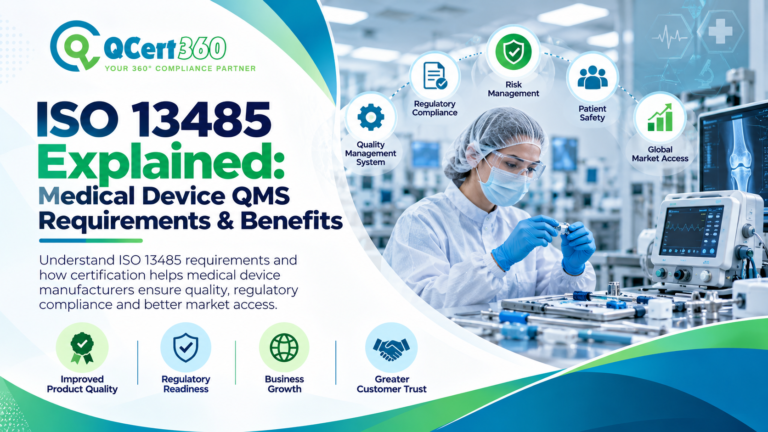
ISO 13485 Explained: Medical Device QMS Requirements and Benefits
ISO 13485 is the international standard for quality management systems (QMS) in the medical device sector. It sets out what an organization must control, document and monitor so that devices, and the services around them, are designed, made and supported consistently and traceably. For manufacturers, suppliers and service providers, it is the common language customers, regulators and auditors use when they ask, “How do you manage quality?”
Most medical device teams hit the same problem sooner or later. A customer asks for an ISO 13485 certificate, a regulator expects a documented quality system, or a distributor wants proof that suppliers are controlled. Without a structured QMS, answers live in people’s heads, records are scattered and every audit becomes a scramble. A well-built medical device QMS replaces that scramble with defined processes, clear ownership and records you can find in minutes.
This guide explains ISO 13485 in plain language: what it is, who needs it, what ISO 13485 requirements cover, how documentation and risk management fit in, how the certification process works, and what drives time and cost. It also shows where QCert360 can help with ISO 13485 consulting services, implementation support and audit readiness, and where independent third-party certification takes over.
Want a scope-based view of your own situation? Request an ISO 13485 certification quotation and QCert360 will review your activities, products and goals before recommending a path.
What Is ISO 13485 for Medical devices?
ISO 13485 specifies quality management system requirements for organizations involved in the medical device life cycle. The current edition is ISO 13485:2016, titled Medical devices – Quality management systems – Requirements for regulatory purposes. Publicly available sources indicate it was reconfirmed after its most recent systematic review, but check the official ISO page for ISO 13485 for the latest status before relying on any edition.
The standard covers organizations that design, develop, produce, store, distribute, install and service medical devices, plus suppliers that provide products or services to them. Its purpose is to help organizations consistently meet customer and applicable regulatory requirements. The phrase “regulatory purposes” matters: the standard supports legal requirements, it does not replace them.
ISO 13485 Implementation vs ISO 13485 certification
Implementing an ISO 13485 QMS means building and running the system inside your organization. Certification is a separate step: an independent certification body audits the system against the standard and, if it conforms, issues a certificate. ISO itself does not certify organizations. The credibility of a certification body is often supported by accreditation, an independent assessment of its competence, commonly coordinated through bodies working under the International Accreditation Forum (IAF).
An organization can implement ISO 13485 without seeking a certificate. Many seek one because customers, tenders or regulatory pathways ask for it.
Why Is ISO 13485 Important for Medical Device Manufacturers?
Medical devices are used on, or by, people who depend on them working as intended. A QMS built on ISO 13485 gives a manufacturer a disciplined way to control the factors that influence safety and performance, from design inputs to complaint feedback. It does not make a device safe on its own, but it creates conditions in which safety is managed on purpose rather than by chance.
- Product safety and performance. Design reviews, verification, validation and release criteria reduce the chance of a weakness reaching the customer.
- Process consistency. Defined, validated processes help different shifts, sites and operators produce the same result.
- Documentation and traceability. Controlled records show what was done, by whom and under which instruction, and traceable materials and batches show what is affected when a problem appears.
- Risk management. The standard expects risk-based thinking in how processes are controlled and decisions are made.
- Supplier oversight. Suppliers of critical materials, components and services are evaluated and monitored in proportion to their effect on the device.
- Customer confidence. An independent certificate gives buyers and partners a recognized reference point.
The practical result is fewer surprises, and more time spent improving the product instead of reconstructing history.
Who Needs ISO 13485 Certification?
Any organization whose activities affect medical device quality may benefit from an ISO 13485 QMS, and some will be asked for certification by customers or market rules. Typical examples include:
- Medical device manufacturers, including makers of equipment, instruments, implants, disposables and software-driven devices.
- In vitro diagnostic (IVD) manufacturers, whose reagents, analyzers and test kits depend on tightly controlled production and design.
- Design and development companies that create devices for others and carry design responsibility.
- Component and material suppliers whose parts feed into finished devices.
- Contract manufacturers and OEM suppliers producing devices or sub-assemblies to a customer’s specification.
- Sterilization, packaging, installation, servicing and distribution providers, where process validation and handling controls matter.
- Startups preparing for supplier qualification, investor due diligence or first market submissions.
Scope depends on activities
The right scope depends on what your organization actually does. A designer that outsources all production has different obligations from a manufacturer running its own cleanroom. The standard allows certain requirements to be treated as not applicable when the organization does not carry out the related activity, provided the justification is documented and does not affect product conformity. Defining scope accurately is one of the most important early decisions.
Is ISO 13485 certification mandatory for medical devices?
Not universally. The standard is voluntary, but some markets, regulatory pathways, tenders and customer contracts require or strongly expect certification, and some regulators incorporate the standard into their own quality system expectations. Check the rules that apply to your device and the markets you plan to serve.
ISO 13485 Requirements for medical devices Explained
ISO 13485:2016 is organized into main clauses 4 to 8: the QMS (4), management responsibility (5), resource management (6), product realization (7), and measurement, analysis and improvement (8). The sections below summarize the ISO 13485 quality management system requirements in practical terms. They describe intent, not exact wording, so use the published standard for audit work.
Medical device Quality management system and documented information
The organization must establish, document, implement and maintain an effective QMS: which processes are needed, how they interact, who owns them and how they are controlled. It must also determine its role under applicable regulatory requirements, because a manufacturer, importer and distributor carry different duties. Software used in the QMS or in production must be validated for its intended use, in proportion to risk.
Management responsibility and quality objectives
Top management must set a quality policy, define measurable quality objectives, provide resources and assign responsibility and authority. Management review at planned intervals examines audit results, feedback, process performance, product conformity and corrective actions. Meeting customer and regulatory requirements is a leadership matter, not only a quality department task.
Personnel competence, infrastructure and work environment
People who affect product quality must be competent through education, training, skills and experience, with records kept. Buildings, equipment and supporting services must be adequate for product conformity. Where the work environment can affect the device, such as contamination control or personnel hygiene, documented requirements and monitoring apply, with extra controls for sterile devices.
Risk management and product realization
The organization must document requirements for risk management across product realization and keep the records. Planning covers objectives, processes, verification and validation activities, resources and required records. Customer-related processes include determining product requirements, reviewing them before commitment and arranging communication, including feedback.
Design and development controls
When the organization is responsible for design, it needs a controlled process: planning, inputs, outputs, reviews, verification, validation, transfer to production, change control and a design and development file. Inputs must include functional, performance, usability, safety and regulatory requirements, along with risk management outputs. This applies only if the organization has design responsibility.
Supplier evaluation and purchasing controls
The organization must set criteria to evaluate, select and re-evaluate suppliers, applying controls in proportion to the effect of the purchased item on the finished device. Purchasing information must describe the product clearly and verification of purchased product must be planned. Quality agreements are common for critical suppliers. Outsourced processes remain the organization’s responsibility.
Production, process validation and service provision
Production and service activities must run under controlled conditions. Where a process output cannot be fully verified by later inspection or testing, the process must be validated. Examples include sterilization, sealing, welding and molding. Where relevant, the standard also covers cleanliness, installation, servicing, sterile device requirements and preservation of product in storage and delivery.
Identification and traceability
Product must be identified throughout realization, and status must be clear so nonconforming or untested product is not released by mistake. Traceability expectations depend on the device and on regulation, and implantable devices carry the strictest requirements. For other devices, traceability still supports complaint handling, field actions and investigations.
Monitoring and measuring equipment
Equipment used to prove conformity must be calibrated or verified at set intervals, protected from damage, identified and recorded. If equipment is found out of tolerance, the organization must assess the effect on earlier results and act on it.
Control of nonconforming product
Nonconforming product must be identified, segregated, evaluated and handled in a documented way, such as rework, concession, scrap or return. If nonconformity is found after delivery, the organization must act appropriately, which may include advisory notices where required.
Complaint handling and feedback
Feedback is a formal QMS input. A documented process must collect, review and act on feedback, decide when a complaint needs investigation and when it must be reported to a regulator, and feed results into risk management.
Corrective action and preventive action
Corrective action removes the cause of an actual nonconformity so it does not recur. Preventive action addresses potential causes before a problem occurs. The usual sequence is review, root cause, decision, implementation, verification that conformity was not harmed, and an effectiveness check, with records throughout.
Internal audits and management reviews
Internal audits check at planned intervals whether the QMS conforms and is effectively implemented. Auditors must be objective and impartial, and findings must be followed up. Results feed management review, which decides on improvements and resourcing.
Measurement, analysis and improvement
The organization must plan monitoring and measurement and analyze data from feedback, product, processes, suppliers, audits and complaints to show whether the QMS works and where it needs to improve.
General requirements versus those that apply only when relevant
Some requirements apply to every organization, such as management commitment, document control, internal audits and corrective action. Others apply only when relevant to the organization’s activities, such as design and development, installation, servicing, sterile device controls and implantable device traceability. A properly scoped QMS documents which clauses apply and why any are excluded.
Talk to QCert360 about ISO 13485 QMS consulting if you are unsure which requirements apply to you.
ISO 13485 Documentation Requirements for Medical devices
ISO 13485 requires two kinds of documented information: documents that tell people how to work, and records that prove the work was done. Controlled documents must be approved, current and available where used. Records must stay legible, identifiable and retrievable for a defined period, which for many devices relates to the device lifetime as set by applicable rules.
Which documents are needed depends on the standard, product type, organizational activities and regulatory requirements. A typical medical device QMS may include:
Document or record | Purpose |
Quality policy and objectives | State direction and measurable goals |
QMS manual | Describe scope, exclusions and process interaction |
Procedures and work instructions | Define how processes are carried out |
Medical device file | Hold specifications, manufacturing and testing details for each device type or family |
Design and development records | Show plans, inputs, outputs, reviews, verification, validation and changes |
Risk management file | Record hazards, analysis, controls and reviews |
Supplier records | Show evaluation, selection, monitoring and agreements |
Training records | Prove personnel competence |
Validation reports | Prove processes and software are fit for use |
Calibration records | Show equipment accuracy and status |
Audit and management review records | Show system checks and leadership decisions |
Complaint and corrective action records | Capture investigations, causes and effectiveness checks |
Two habits keep documentation workable. Write procedures to match what people really do, and keep the system as lean as the risk allows. A short, accurate procedure that people follow beats a long one nobody opens.
What documents are required for ISO 13485 for Medical devices?
The standard names specific documented procedures, such as document control, record control, internal audit, nonconforming product control and corrective action, plus required records. The exact list depends on scope and regulatory context, so confirm it against the published standard
ISO 13485 and Medical Device Risk Management
Risk management means identifying what could go wrong, judging how serious and likely it is, applying controls and checking that the controls work, across the whole product life cycle. ISO 13485 requires risk-based thinking in QMS processes and documented risk management in product realization.
ISO 13485 and ISO 14971
ISO 14971 is the standard dedicated to applying risk management to medical devices. It describes hazard analysis, risk estimation and evaluation, risk control, residual risk assessment and production and post-production review. The two standards are complementary, not interchangeable. ISO 13485 sets requirements for the QMS that runs the organization, while ISO 14971 provides a detailed process for managing device risk. A QMS can reference ISO 14971 as its risk method, and many regulators and certification bodies expect to see it used. Conforming to one does not demonstrate conformity to the other. Confirm the current edition of ISO 14971 on ISO’s website.
Practical examples (hypothetical illustrations, not client cases)
- Design change. A manufacturer switches a plastic housing material to cut cost. A risk review asks whether biocompatibility, strength or cleaning compatibility is affected, and whether verification and validation must be repeated before release.
- Critical component. A battery supplier is classed as critical because failure could affect function. The organization sets tighter incoming inspection, a quality agreement and periodic supplier audits.
- Production process. A sealing process for sterile packaging cannot be fully verified by inspection. Risk analysis marks it for validation with defined parameters, monitoring and revalidation triggers.
- Supplier failure. A supplier changes a raw material without notice. A purchasing agreement requiring change notification, plus incoming checks, limits the chance of the change slipping through.
- Product complaints. Several complaints describe a loose connector. The complaint process triggers an investigation, the risk file is reviewed and corrective action updates design or assembly controls.
ISO 13485 Certification Process for Medical devices: Step by Step
The ISO 13485 certification process moves from defining scope, through building and testing the QMS, to independent assessment and ongoing surveillance.
- Define the certification scope. Decide which products, sites, activities and processes the QMS and certificate will cover, and document any exclusions with justification.
- Conduct an ISO 13485 gap analysis. Compare current practice against the standard and your regulatory role to see what exists and what is missing.
- Develop or update QMS documentation. Prepare the policy, procedures, work instructions and forms the QMS needs, in proportion to your size and risk.
- Implement required processes and maintain records. Put the procedures into daily use. Records from real operation are what auditors test.
- Train relevant employees. Make sure people understand their responsibilities and how their work affects product quality.
- Conduct internal audits. Audit the whole system, including design, purchasing, production, complaints and corrective action.
- Complete management review and resolve issues. Top management reviews performance and decides actions. Close open findings before the external audit.
- Undergo the certification body’s assessment. The independent body audits the QMS, commonly in two stages: a readiness and documentation review, then an assessment of implementation.
- Address nonconformities where necessary. If findings arise, correct them and show root cause and corrective action under the certification body’s rules.
- Maintain the QMS through surveillance and recertification. After certification, periodic surveillance audits and a recertification audit follow within the certificate cycle.
The exact process, audit duration and timeline depend on the organization, scope, applicable certification rules and audit findings.
How long does ISO 13485 certification take for Medical devices?
There is no universal timeline. It depends on size, scope, QMS maturity, resources, certification body scheduling and findings. Organizations with an existing ISO 9001 system or mature processes often move faster than those starting from nothing, and any fixed promise of duration deserves caution.
Ready to map your own route? Request an ISO 13485 gap assessment from QCert360 to see which steps apply to you.
Benefits of ISO 13485 Certification
The benefits come from running a disciplined QMS and having it independently verified, and they depend on how effectively the system is implemented. No standard guarantees fewer recalls, regulatory approval, market access or increased sales. Within that limit, organizations commonly aim for:
- More consistent product quality through defined and validated processes.
- Better control of product-related risks by building risk thinking into design, purchasing and production.
- Improved documentation and traceability, which speeds investigations and audits.
- Stronger supplier management, including better control of outsourced processes.
- Improved handling of nonconformities and complaints, with clearer root cause analysis and action tracking.
- Greater confidence among customers and business partners who recognize the standard.
- Support for regulatory and customer assessment activities, since a documented QMS answers many assessor questions.
- Improved readiness for supplier qualification and global business opportunities, because many buyers screen suppliers for a recognized QMS.
For startups, building the QMS early can also avoid costly rework, because design records and risk files are created as the product develops rather than reconstructed later.
What Does an ISO Auditor Check in a Recycling Facility?
An ISO auditor checks whether your documented system matches real operations. They walk the site, observe work, review records and interview staff. They rely on objective evidence, not promises.
What does an ISO auditor check in a recycling facility? Expect focus on:
- Incoming material inspection and rejection records
- Scale calibration and weighing accuracy
- Storage layout, segregation and fire controls
- Machine guarding, isolation and safe work methods
- Waste, spill and emissions controls
- Training records and competence evidence
- Supplier and downstream buyer evaluation
- Incident, complaint and corrective action files
- Internal audit and management review results
The best preparation is simple: follow your own procedures every day.
ISO 13485 for Medical devices vs ISO 9001 for Medical devices
ISO 9001 is a general quality management standard for any industry. ISO 13485 is specific to medical devices and has a regulatory focus. ISO 9001 emphasizes customer satisfaction and continual improvement, while ISO 13485 emphasizes maintaining an effective QMS, meeting regulatory requirements and controlling device safety and performance.
Aspect | ISO 9001 | ISO 13485 |
Purpose | Consistent quality and customer satisfaction in any sector | Consistent device quality and regulatory conformity |
Industry applicability | All industries and sizes | Organizations in the medical device life cycle and their suppliers |
Regulatory focus | Applicable requirements are considered | Regulatory requirements are central and shape the QMS |
Risk management | Risk-based thinking across the organization | Documented risk management in product realization, often using ISO 14971 |
Design controls | General design and development requirements | Detailed design file, reviews, transfer and change control |
Documentation | Flexible, decided by the organization | More prescriptive procedures and records, including a medical device file |
Traceability | Where it is a requirement | Detailed requirements, strictest for implantable devices |
Device-specific processes | None | Sterile device controls, installation, servicing, cleanliness, process validation, feedback and reporting |
Should you implement both?
An organization may benefit from both when it serves medical and non-medical customers, or wants a broader management system aligned with its medical device QMS. Organizations holding ISO 9001 often build ISO 13485 on familiar processes, but the additional requirements are significant and ISO 9001 certification does not stand in for ISO 13485.
ISO 13485 and International Regulatory Expectations
ISO 13485 is a QMS standard. Medical device market authorization and product conformity are separate matters governed by the regulators of each market. A device must meet the requirements of the market where it is sold, and a QMS certificate does not replace them.
At a high level, many regulators expect manufacturers to operate a quality system, and some refer to ISO 13485 directly or align with it. International cooperation, including the work of the International Medical Device Regulators Forum (IMDRF), has encouraged more consistent approaches. Programs such as the Medical Device Single Audit Program (MDSAP) use ISO 13485 as a foundation alongside additional requirements from participating regulators, so such audits are broader than a conventional ISO 13485 certification audit.
Does ISO 13485 certification guarantee regulatory approval?
No. Certification does not automatically authorize a company to sell a device in any market. Devices may still need classification, technical documentation, clinical evidence, registration or conformity assessment. Confirm market requirements with the relevant regulator or a qualified regulatory adviser.
ISO 13485 Certification Timeline and Cost
ISO 13485 certification cost and timeline depend on your size, scope and starting point, so this page quotes no fixed prices or durations. The main factors are:
- Company size and workforce. More people and processes mean longer audits and more training.
- Number of sites. Each site in scope may need to be audited.
- Product complexity and risk. Higher-risk devices need deeper design, validation and traceability controls.
- Scope and design responsibilities. Design responsibility adds requirements.
- Outsourced processes. More outsourcing means more supplier control work.
- QMS maturity. Existing procedures and records reduce development effort.
- Audit duration. Certification bodies calculate audit time from employee numbers, scope and complexity.
- Findings. Nonconformities and follow-up add effort.
Costs typically fall into three groups: internal effort, external consulting or implementation support, and certification body fees for initial, surveillance and recertification audits.
HHow much does ISO 13485 certification cost for Medical devices?
It varies by scope, size and complexity. The most reliable route to a figure is a scope-based assessment followed by a quotation. Request an ISO 13485 certification quotation from QCert360 to discuss your activities and goals.
Common ISO 13485 Implementation Challenges for Medical devices
Most implementation problems come from a handful of repeating causes.
Challenge | Why it happens | Practical guidance |
Incomplete documentation | Procedures written late or copied from templates | Map every applicable clause to a procedure or record, then test against real practice |
Weak design controls | Design treated as informal engineering | Define stages, reviews, verification and validation, and keep a traceable design file |
Inadequate supplier evaluation | Suppliers chosen on price and delivery alone | Classify suppliers by risk, set criteria, use quality agreements and monitor performance |
Insufficient traceability | Batch or component records not linked | Decide the traceability level early and test it with a mock recall |
Unvalidated processes | Assuming inspection is enough | List processes that cannot be fully verified and validate them, including software |
Inconsistent records | Forms filled in late or partly | Simplify forms, train users and review records in internal audits |
Ineffective corrective actions | Fixing symptoms, not causes | Use structured root cause methods and verify effectiveness |
Two further points help. Involve operators and engineers in writing procedures, because they know where problems really occur. And treat internal audits as rehearsal: a problem found internally is one you avoid as an external nonconformity.
Facing one of these challenges now? Contact QCert360 for ISO 13485 implementation support and discuss a practical plan.
Current Medical Device Quality Management Trends
The points below separate established practice from emerging direction. No market size or growth figures are quoted, because reliable numbers should come from dated, verifiable sources.
Established practices
- Risk-based control of QMS processes. Scaling controls to risk is built into ISO 13485:2016 and is standard practice.
- Supplier and outsourced process oversight. Regulators and auditors continue to look closely at it.
- Software validation in the QMS. ISO 13485 already requires validation of software used in the QMS, production and monitoring, in proportion to risk.
- Stability of the standard. Publicly available sources indicate ISO 13485:2016 was reconfirmed after a recent systematic review, giving organizations a stable planning reference. Check ISO’s page for the current position.
Emerging and growing trends
- Electronic QMS platforms and digital document control. Many organizations are moving from paper and spreadsheets to systems that manage documents, training, audits and corrective actions together. These tools still need validation and clear ownership.
- Automated audit trails and data integrity. Reliable timestamps, access control and change history make electronic records easier to trust.
- Connected device quality risks. Software, connectivity and data features add cybersecurity, update and performance considerations to design and post-market processes.
- Greater supplier transparency. Shared data and closer collaboration help spot issues earlier.
- Risk management in operational decisions. Risk information increasingly informs change control, complaint review and supplier decisions as they happen, instead of sitting in a file reviewed once a year.
Tools do not fix weak processes. Digitizing a confusing procedure only produces a faster confusing procedure, so start with clear processes and then choose supporting tools.
How QCert360 Can Support ISO 13485 Implementation and Certification
QCert360 is a global ISO certification and management consulting firm that helps organizations understand, build and prepare their management systems. For ISO 13485, QCert360 can support you with:
- ISO 13485 gap assessment to compare current practice with the standard and set priorities.
- QMS implementation guidance tailored to your size, products and activities.
- Documentation development support for policies, procedures, work instructions and records.
- Risk management process guidance to connect your QMS with a structured device risk process.
- Employee awareness and training so teams understand their roles.
- Internal audit preparation, including planning and finding follow-up.
- Nonconformity and corrective action support with root cause and effectiveness checks.
- Certification audit readiness before the independent assessment.
- Assistance in understanding certification scope and requirements, so the certificate matches your real activities.
ISO 13485 Consulting versus independent certification
Consulting and implementation support help you build and prepare the QMS. Independent third-party certification is a separate assessment by a certification body, and its decision cannot be guaranteed or influenced by a consultant. Confirm the accreditation status and scope of any certification body before engaging it, and do not assume a consulting engagement results in a certificate.
Start the conversation
Whether you are a startup preparing a first QMS, a component supplier answering customer requirements or an established manufacturer refreshing your system, QCert360 can help you choose the next practical step. Contact QCert360 for ISO 13485 consulting, implementation support or a tailored certification quotation.
Frequently Asked Questions About ISO 13485
- Can a small company implement ISO 13485 without a large quality team? Yes. The standard scales with scope and risk, so a small team can run a lean QMS if responsibilities are clear and records are kept consistently. Many small manufacturers and startups use external guidance to avoid building more documentation than they need.
- Does ISO 13485 apply to medical device software? Yes, where the organization designs, develops or supports software that is a medical device or part of one. Design controls, risk management, change control and software validation apply in proportion to the software’s role and risk.
- What is a medical device file? It is a collection of documents for each device type or family. It typically holds product descriptions, specifications, manufacturing and packaging details, test and release criteria, and installation or servicing instructions where relevant.
- How often are audits carried out after certification? Certification bodies commonly run surveillance audits during the certificate cycle and a recertification audit before it ends. The exact frequency and duration depend on the certification body’s rules and your scope.
- What is the difference between a gap analysis and an internal audit? A gap analysis compares your current practice with the standard, usually at the start, to show what is missing. An internal audit checks an implemented QMS for conformity and effectiveness, and the standard requires it.
- Do component suppliers need their own ISO 13485 certification? Not always. Manufacturers decide how to control suppliers based on risk. Some require certification from critical suppliers, while others rely on audits, agreements and incoming checks. Customer contracts often set the expectation.
- What happens if the auditor finds a nonconformity? The organization investigates the cause, corrects the issue and shows evidence of corrective action within the timeframe set by the certification body. The certification decision depends on how the findings are resolved.
- Can some ISO 13485 clauses be excluded? Some requirements can be treated as not applicable when the organization does not carry out the related activity, such as design or installation. The exclusion must be justified and documented, and it cannot affect the ability to deliver conforming product.
- Is ISO 13485 certification the same as a device approval or conformity mark? No. A QMS certificate shows that a management system was assessed. Device approvals, registrations and conformity marks are separate regulatory outcomes for specific products in specific markets.
- What role does top management play? Top management sets the quality policy and objectives, provides resources, assigns authority and reviews QMS performance. Auditors expect to see leadership involvement, not everything delegated to the quality department.
- Do I need ISO 14971 to be ISO 13485 certified? ISO 13485 requires documented risk management in product realization, and ISO 14971 is the widely used method for it. Check your certification body’s and regulators’ expectations for your device before choosing another approach.
- What does an ISO 13485 engagement with QCert360 usually start with? It typically starts with a scope discussion and gap assessment so the support matches your products, activities and goals. Contact QCert360 to request a scope-based assessment or quotation.
- How should we prepare for an ISO 13485 audit? Run a full internal audit and a management review first, close any open findings, and check that records match your procedures. Make sure the people being interviewed can explain their own processes. Mock traceability and complaint exercises are also useful rehearsals.
- Is ISO 13485 only for medical device manufacturers? No. It can also apply to organizations that design, store, distribute, install or service devices, and to suppliers of products or services to them. The scope you define determines which requirements apply.
- What is the difference between corrective action and preventive action? Corrective action removes the cause of a nonconformity that has already happened. Preventive action addresses a potential cause before a problem occurs. Both need documented investigation, implementation and an effectiveness check.
- Does ISO 13485 require electronic QMS software? No. Paper and spreadsheets can meet the standard if documents and records are controlled. If you do use software in the QMS or in production, it must be validated for its intended use in proportion to risk.
- What is the difference between ISO 13485 implementation support and certification? Implementation support helps you build and prepare your QMS. Certification is a separate independent audit by a certification body, and a consultant cannot guarantee or influence its decision.
Start Your ISO Certification Journey for Recycling business with QCert360
Recycling companies succeed when they combine performance with proof. ISO certification gives you that proof across environment, quality and safety. It helps you win contracts, protect your people and build trust with everyone who depends on your output.
Talk to QCert360 today for a free consultation and a certification quote tailored to your recycling business.
[Get Your Free ISO Certification Quote for Recycling Business]
Our Services
ISO Standards
- ISO 9001 Certification
- ISO 14001 Certification
- ISO 45001 Certification
- ISO 22000 Certification
- ISO 17025 Certification
- ISO 27001 Certification
- ISO 13485 Certification
- ISO 20000-1 Certification
- ISO 41001 Certification
- ISO 22716 Certification
- ISO 50001 Certification
- ISO 22301 Certification
- ISO 29993 Certification
Product Certifications
Other international standards
- FSSC 22000 Certification
- HIPAA
- HACCP Certification
- SA 8000 Certification
- GMP Certification
- GDPR
- GDP Certification
- GLP Certification
- Certificate of Conformity
QCert360 provides a wide range of services including ISO certification, audit support, compliance consulting, and training. They specialize in helping businesses achieve global standards and certifications like ISO 9001, ISO 27001, ISO 14001, and many others. Their team ensures a seamless experience from consultation to certification, supporting clients at every stage.
The time it takes to achieve certification can vary depending on the complexity of the standard and the readiness of your organization. On average, it takes about 3 to 6 months. QCert360 works closely with clients to streamline the process, ensuring that all requirements are met efficiently and within a reasonable timeline.
QCert360 is a trusted partner with years of experience in helping businesses obtain international certifications. Their expert consultants provide tailored solutions, ensuring your organization not only meets but exceeds industry standards. With a customer-centric approach, they focus on offering end-to-end support to simplify the certification journey.
QCert360 serves a wide range of industries including manufacturing, healthcare, information technology, education, and services, among others. They customize their certification solutions to meet the unique requirements of each industry, ensuring relevance and compliance with global standards.
Yes, QCert360 provides ongoing support even after certification. They offer services like surveillance audits, recertification guidance, and consultancy to help maintain and improve your certification status. Their team ensures that your organization stays compliant and up-to-date with any changes in certification standards.
Getting started with QCert360 is simple. You can contact them via their website to request a consultation. Their team will assess your needs, discuss the best certification options for your business, and outline the steps involved. From there, they’ll guide you through the entire process, ensuring you’re prepared for certification.
QCert360 stands out due to its customer-focused approach, industry expertise, and comprehensive service offerings. Their team doesn’t just help you obtain certification but works to ensure your organization thrives in compliance with international standards. They also offer personalized consultation, making the process smoother and more efficient, ensuring long-term success for your business.
The cost of certification varies depending on factors such as the type of certification, the size and complexity of your organization, and the specific industry requirements. QCert360 offers competitive pricing and provides tailored quotes based on your unique needs. They ensure transparency and work with you to find the most cost-effective solution for your certification goals.
Yes, QCert360 offers internal audit services to help assess and improve your organization’s processes. Their expert auditors conduct thorough reviews of your systems and operations to ensure they meet required standards. They also provide actionable recommendations to help enhance efficiency and compliance, making sure you’re fully prepared for external audits.
If your organization doesn’t pass an audit or certification assessment, QCert360 works with you to understand the reasons for non-compliance and provides support to rectify the issues. They offer guidance on corrective actions and help you prepare for a re-assessment. Their goal is to ensure your organization meets the necessary standards for certification, and they will be by your side to make the process as smooth as possible.